The geology of Southwest Ghana is dominated by the Birimian Supergroup metasedimentary and metavolcanic rocks and various granitoid intrusions. Granitoid intrusions are subdivided into two types: Belt Type (Dixcove) granitoid and Basin Type (Cape Coast) granitoid. Belt type granitoids (ca. 2180 Ma, Allibone et al. 2004) possess a metaluminous character, are often tonalite to granodiorite and are confined to Biriman metavolcanic belts Hirdes and Leube 1989). Basin granitoid ( -2116-2088 Ma. Allibone et al. 2004b) have a peraluminous character GIST and higher K and Rb relative to belt granitoids are mainly granodiorite, and associated with the central portions of Birimian metasedimentary basins (Hirdes and sube 1989).
Within the Birimian Supergroup, northeast striking mafic metavolcanic belts are separated from intervening metasedimentary (dominantly turbiditic) basins by major faults. These faults probably controlled early syn - Birimian sedimentary basin down - faulting (Hirdes and Leube 1989). The two largest and best known of the Birimian metavolcanic belts are the Ashanti Belt and Sefwi-Bibiani Belt.
Dating of granitoid rocks (Belt Type granitoids) that cut the Birimian metavolcanic rocks constrains the age of these rocks as greater than ca. 2186 Ma. Detrital zircons in the Birimian metasedimentary rocks yield U-Pb ages between 2187and 2130 Ma, indicating deposition of both units occurred after 2130 Ma. Granitoid rocks (Basin type) that intrude the Birimian metasediments and Tarkwaian Group have U-Pb zircon ages of 2116 to 2088 Ma, which indicates deposition of both sedimentary packages occurred prior to 2116 Ma. Allibone et al, (2002) suggest that the compression, polyphase deformation and metamorphism of all Birimian rocks happened contemporaneously with the intrusion of basin type granitoid rocks and probably reactivated the Belt bounding faults and thrust faults. U-Pb geochronology on ore related titanite in the Ashanti deposit indicates that gold mineralisation occurred at ca. 2100 2090 Ma (Oberthür et al .1998), at the later stages of this event. Allibone et al, (2002) suggests that the last phase of deformation was predominantly sinistral strike slip faulting resulting in gold ore - hosting shear zones.
The Sefwi Belt is one of Ghana's largest belts volcanic belts with prominent gold deposits on the northwest and southeast margins. The Belt consists of extensive mafic volcanic rocks and widespread Belt - type dioritic intrusive bodies, some of which host gold mineralization as at Newmont's Ahafo Mine along the northwest margin of the belt. Here gold is being produced from 4 individual open pit operations. Along the southeast margin, the Mine and Miner occur along structures that form the sheared margin of the belt. Tarkwaian rocks occur along the margin of this belt near the Chirano Mine.
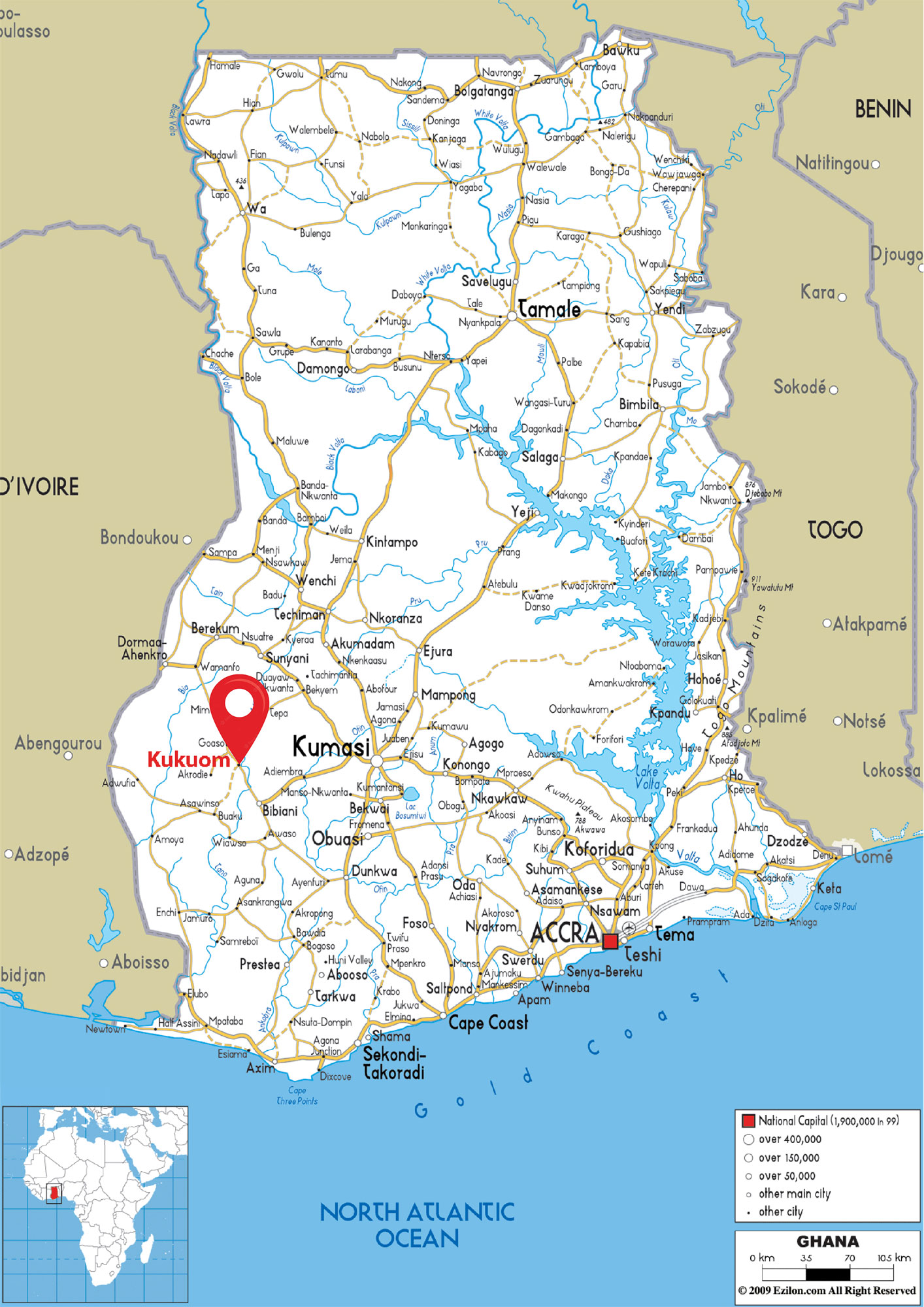
The Kukuom concession is located along the western part of the Paleoproterozoic Sefwi Bibiani Belt, proximal to the contact with the Sunyani basin. The concession is dominated by strongly foliated metasedimentary rocks featuring argillitic and volcanoclastics sediments (wackes). The western tip of the concession features basin - type granitoids with biotite as the dominant mafic mineral.
Gold mineralization in this area is associated with wide zones of pervasive to fracture controlled quartz-sericite- carbonate-pyrite alteration in sheared and locally brecciated, altered granitoid rocks and to a lesser extent brecciated hematite-altered mafic metavolcanic rocks.